LipoDyne Official Website › Choosing A Supplement
Choosing A SupplementChoosing A Metabolism Supplement: Seven Checks
Seven questions you can answer standing in a shop with a bottle in your hand, each one worth more than the front label. They cover printed amounts, standardisation, the stimulant total, artwork against panel, origin, the return window and whether any testing document exists. At the end, this product is scored against all seven, failures included.
A scorecard you can carry to any label, then run on the one this website sells.
Why seven checks beat comparing two front labels
What front labels hide, and what the back of a bottle gives away.
Front labels in this category are close to interchangeable. They name the same handful of botanicals, use the same permitted phrasing, and carry seals that look like certifications. Comparing two of them is comparing two design briefs.
The back of a bottle is where products actually separate. One panel prints an amount against every row and another prints a single blend total; one names a standardisation percentage and another does not; one seller states where the parcel ships from and another leaves it to be discovered at customs. Those differences decide what a buyer is getting.
The seven below are ordered by how much they tell you. The first two are worth more than the other five combined, and a bottle that fails either of them is difficult to assess at all.
The seven checks
Seven questions, ordered by how much each one tells you.
1. Is an amount printed against every active?
A proprietary blend gives one total for several ingredients, so nobody outside the manufacturer knows the split. A panel with a figure on every row can be assessed; a blend can only be trusted. This is the check that matters most.
2. Is the standardisation percentage printed beside each extract?
“Green tea extract 250 mg” is a weight of extract. “Green tea extract 250 mg, standardised to 50% catechins” is a dose. Without the percentage, a true milligram still cannot be compared with any trial.
3. Is the stimulant amount stated, and does it fit your day?
Caffeine is the ingredient in this category with the most reliable effect and the clearest ceiling. A label that prints its figure lets you add it to your coffee; one that hides it inside a blend does not.
4. Does the marketing artwork agree with the panel?
Graphics are produced separately from the label. Where a graphic promises something the panel does not contain, that is a straightforward contradiction and it tells you how carefully the rest of the material was prepared.
5. Does the seller say where it ships from and how long it takes?
A stated origin and a stated delivery window are checkable promises. An unstated origin usually means a border, a longer wait and possibly an import charge, discovered after paying rather than before.
6. Is there a return window with an actual day count, and who pays the postage?
“Satisfaction guaranteed” with no number attached is not a term. A day count, a starting event and a line about who pays return shipping are the three things that make a guarantee usable.
7. Is there a testing document, or only a reference number?
A lot code and a certificate reference are strings that let a seller find a batch. A certificate of analysis is a document with results in it. Many sellers publish the first and describe it as if it were the second.
LipoDyne scored against all seven
Seven checks, four passes and three failures, with the evidence for each.
| Check | Result | What the label or listing actually shows |
|---|---|---|
| 1. Amount against every active | Pass | Six rows, six amounts, no proprietary blend, 1,060 mg in total. This is the strongest thing about the label. |
| 2. Standardisation percentage | Fail | Not printed on any of the four botanical extract rows. The garcinia, green tea, cayenne and pepper rows give extract weight with no percentage, so their active content cannot be calculated. |
| 3. Stimulant amount stated | Pass | Caffeine anhydrous 100 mg, printed on its own row. Roughly one cup of coffee, and a quarter of the 400 mg a day the safety reviews describe for healthy adults. |
| 4. Artwork agrees with the panel | Fail | The wellness graphic ends on “Vital vitamins and minerals”. The panel carries six botanical and stimulant rows and no vitamin or mineral of any kind. |
| 5. Origin and delivery stated | Pass | Surat, Gujarat, India, India as country of origin, standard international shipping, and the seller’s own 15 to 25 business days after dispatch. Customs payable by the buyer is stated too. |
| 6. Return window with a day count | Pass | 30 days from delivery, with the listing stating the seller pays return shipping and the marketplace money-back guarantee behind it. |
| 7. Testing document published | Fail | Lot LIP-26/GO-7994 and certificate reference LIP-7994-26-GO are reference strings. No certificate of analysis is published for this product. |
Four passes, three failures. The failures are printed in the same table as the passes because a scorecard that only shows the good rows is a review score.
The shape of that result is worth a sentence, because it is unusual. This label is better than its category on the check that matters most and worse than it needs to be on the one immediately after. It prints everything except the percentages that would make the printed numbers comparable.
The seal wall is a related story. Four badges ship on this pack, and the testing page reads each of them out loud: a facility registration described as if it were approval, a GMP mark naming no certifier, a sourcing disclosure naming no country, and a money-back roundel with no day count on it while the listing prints 30.
The three failures, in detail
What each failure actually costs a buyer, and what it does not.
No standardisation percentage
This is the expensive one. the 1998 JAMA trial used 1,500 mg of hydroxycitric acid; this panel gives 500 mg of garcinia extract. Nagao's 583 mg catechin trial used 583 mg of catechins; this panel gives 250 mg of green tea extract. In both cases the label figure is true and the comparison is impossible, because the number that converts one to the other is not on the bottle.
Artwork that contradicts the panel
The seller’s wellness graphic promises vitamins and minerals. The panel contains six botanical and stimulant rows and no vitamin or mineral. Both documents came from the same seller, and only one of them is the label. It is worth knowing which materials are held to which standard.
No published certificate of analysis
Lot LIP-26/GO-7994 identifies a production run and LIP-7994-26-GO is a certificate reference. Neither is a result. A published certificate would name the laboratory, the date, the assay and the figures it returned, and none of that is available for this product.
None of those three is a safety finding and none of them means the bottle contains something other than what the panel says. They are limits on what a careful buyer can verify, and a scorecard exists to make limits visible rather than to condemn.
the DILIN assay of supplement contents is why the third one is not merely pedantic: when supplements implicated in liver injury were assayed, contents and labels did not always agree. A published certificate is the document that closes that gap, and a reference number is not.
The four passes, and which one is worth most
Two passes on the bottle, two on the listing, and one caveat attached to the last.
Check one is the valuable pass. A panel with a figure against every row is a minority position in this aisle, and it is what makes the rest of this website possible: every sentence about an amount on the ingredients page exists because the amount is printed.
Check three is the second. A stated 100 mg of caffeine lets a buyer do the only piece of arithmetic that genuinely matters day to day, which is adding it to the coffee they were going to drink anyway. It is also the one row on this panel present at the amount its own research used: Dulloo's 100 mg thermogenesis study gave exactly 100 mg.
Checks five and six are the commercial ones and they pass on the listing rather than on the bottle. The origin, the delivery estimate and the customs position are all stated, and the return window has a number, a starting event and a line about postage. That is more than many sellers in this category publish.
One caveat belongs with check six rather than against it. The money-back seal printed on the pack carries no day count at all, and a sixty-day window appears in the supplier’s review summary and nowhere on the listing. The figure this website uses throughout is the listing’s 30 days, and the guarantee page explains why.
Running the same seven checks on a different bottle
How long each of the seven takes when the bottle is in your hand.
The scorecard is more useful on a product this website does not sell, so here is how to run it quickly. Turn the bottle over first and photograph the panel, because the front will not answer any of the seven.
Check one takes five seconds: look for the word “blend” or “proprietary” and for a single total covering several named ingredients. Check two takes another five: look for a percentage or a ratio beside each extract. If both fail, the panel cannot be assessed and the remaining five checks are about the seller rather than the product.
Check three needs your own arithmetic rather than the label’s. Add the stated caffeine to what you already drink. Check four needs the seller’s website open beside the bottle, which is where the contradictions live.
Checks five, six and seven are all on the listing or the seller’s own pages, and all three are answerable before paying. A seller that will not say where a parcel ships from has answered the question.
What the seven checks cannot tell you
Four things a label-reading scorecard is structurally unable to settle.
They cannot tell you whether a product will work for you. Every one of them is about what can be verified from a label and a listing, and none of them is a measurement of an effect.
They cannot substitute for the category’s own base rate. a review of 315 weight-loss supplement trials found 52 adequate trials out of 315, and a meta-analysis of isolated compounds found no isolated compound reaching 2.5 kg. A bottle that passes all seven checks is a well-documented member of a category with modest results.
They cannot catch a contents problem. A panel is a statement of what should be in the capsule; only an assay establishes what is, which is exactly what check seven is looking for and rarely finds.
And they cannot weigh a price. A scorecard says nothing about whether $22.62 for 60 capsules is fair, which is a judgement about what the same money buys elsewhere. The pricing page does that arithmetic for this bottle.
Who publishes this LipoDyne website?
- Dulloo AG, Geissler CA, Horton T, Collins A, Miller DS. Normal caffeine consumption: influence on thermogenesis and daily energy expenditure in lean and postobese human volunteers. Am J Clin Nutr. 1989;49(1):44-50. PMID 2912010. https://pubmed.ncbi.nlm.nih.gov/2912010/
- Wikoff D, Welsh BT, Henderson R, et al. Systematic review of the potential adverse effects of caffeine consumption in healthy adults, pregnant women, adolescents, and children. Food Chem Toxicol. 2017;109(Pt 1):585-648. PMID 28438661. https://pubmed.ncbi.nlm.nih.gov/28438661/
- Heymsfield SB, Allison DB, Vasselli JR, Pietrobelli A, Greenfield D, Nunez C. Garcinia cambogia (hydroxycitric acid) as a potential antiobesity agent: a randomized controlled trial. JAMA. 1998;280(18):1596-600. PMID 9820262. https://pubmed.ncbi.nlm.nih.gov/9820262/
- Nagao T, Hase T, Tokimitsu I. A green tea extract high in catechins reduces body fat and cardiovascular risks in humans. Obesity (Silver Spring). 2007;15(6):1473-83. PMID 17557985. https://pubmed.ncbi.nlm.nih.gov/17557985/
- Kondo T, Kishi M, Fushimi T, Ugajin S, Kaga T. Vinegar intake reduces body weight, body fat mass, and serum triglyceride levels in obese Japanese subjects. Biosci Biotechnol Biochem. 2009;73(8):1837-43. PMID 19661687. https://pubmed.ncbi.nlm.nih.gov/19661687/
- Whiting S, Derbyshire E, Tiwari BK. Capsaicinoids and capsinoids. A potential role for weight management? A systematic review of the evidence. Appetite. 2012;59(2):341-8. PMID 22634197. https://pubmed.ncbi.nlm.nih.gov/22634197/
- Shoba G, Joy D, Joseph T, Majeed M, Rajendran R, Srinivas PS. Influence of piperine on the pharmacokinetics of curcumin in animals and human volunteers. Planta Med. 1998;64(4):353-6. PMID 9619120. https://pubmed.ncbi.nlm.nih.gov/9619120/
- Batsis JA, Apolzan JW, Bagley PJ, et al. A Systematic Review of Dietary Supplements and Alternative Therapies for Weight Loss. Obesity (Silver Spring). 2021;29(7):1102-1113. PMID 34159755. https://pubmed.ncbi.nlm.nih.gov/34159755/
- Bessell E, Maunder A, Lauche R, Adams J, Sainsbury A, Fuller NR. Efficacy of dietary supplements containing isolated organic compounds for weight loss: a systematic review and meta-analysis of randomised placebo-controlled trials. Int J Obes (Lond). 2021;45(8):1631-1643. PMID 33976376. https://pubmed.ncbi.nlm.nih.gov/33976376/
- Navarro V, Avula B, Khan I, et al. The Contents of Herbal and Dietary Supplements Implicated in Liver Injury in the United States Are Frequently Mislabeled. Hepatol Commun. 2019;3(6):792-794. PMID 31168513. https://pubmed.ncbi.nlm.nih.gov/31168513/
- Using Dietary Supplements Wisely. National Center for Complementary and Integrative Health, National Institutes of Health. https://www.nccih.nih.gov/health/using-dietary-supplements-wisely
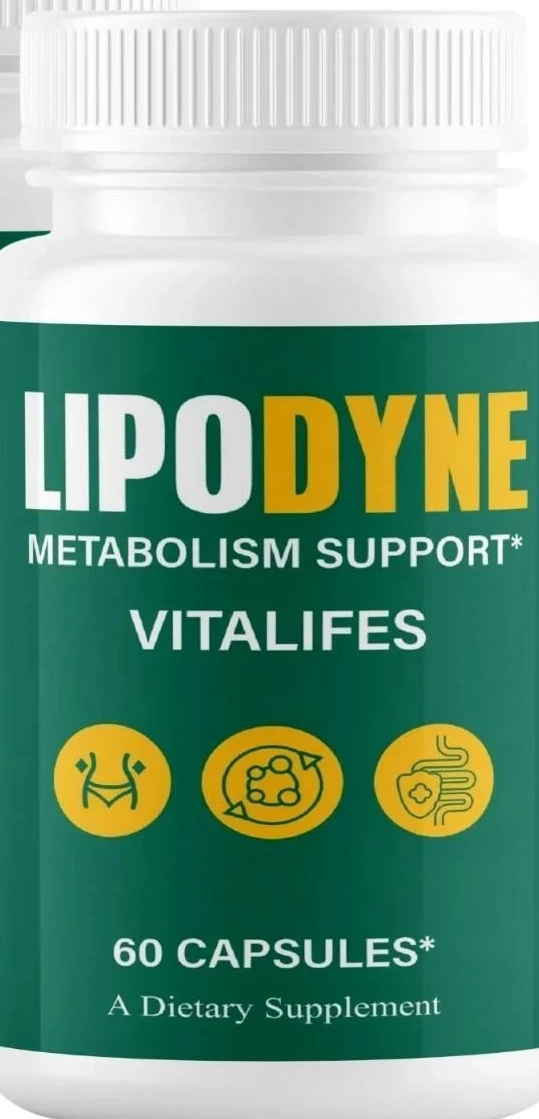
LipoDyne passes four of the seven, and the three failures are above
Six printed amounts with no proprietary blend, 100 mg of caffeine stated on its own row, a stated origin and a 30-day return window with the postage paid by the seller.
$22.62 a bottle, 60 capsules · 30-day returns, seller pays postage
Order LipoDyne On The Official WebsiteOne capsule a day · 60 per bottle · lot LIP-26/GO-7994