LipoDyne Official Website › Ingredients
IngredientsLipoDyne Ingredients
Six actives, and the bottle prints an amount beside every one of them.
One capsule carries garcinia cambogia extract 500 mg, green tea extract 250 mg, apple cider vinegar powder 150 mg, caffeine anhydrous 100 mg, cayenne pepper extract 50 mg and black pepper extract 10 mg, which comes to 1,060 mg. One of those six is present at the amount its own research used.
Every row read for what a buyer can verify from the bottle, and what the bottle leaves for somebody else to answer.
What are the six LipoDyne ingredients?
Each row with the one thing it settles and the one thing it hands on.
| Row, as printed | What the material is | What the row settles | What it leaves open |
|---|---|---|---|
| Garcinia Cambogia Extract (fruit rind), 500 mg | A concentrate of the rind of a South Asian fruit, taken for its hydroxycitric acid. | The plant, the part of it used, and the weight of extract in the capsule. | The strength of the concentrate, since no hydroxycitric acid percentage appears. |
| Green Tea Extract (Camellia sinensis) (leaf), 250 mg | A concentrate of tea leaf, taken for its catechins and for EGCG in particular. | The species, the leaf, and the weight of extract. | The catechin and EGCG share of that weight, which decides everything else. |
| Apple Cider Vinegar Powder, 150 mg | Vinegar dried onto a carrier so it can be capsuled rather than poured. | That the ingredient is a dried powder and not a liquid. | The acetic acid content, which is what vinegar research measures. |
| Caffeine Anhydrous, 100 mg | Dried caffeine, a single defined compound rather than a plant concentrate. | Everything. A milligram of caffeine is a milligram of caffeine. | Nothing. This is the only row with no interpretation left in it. |
| Cayenne Pepper Extract, 50 mg | A concentrate of chilli fruit, taken for its capsaicinoids. | The plant and the weight of extract. | The capsaicinoid content, the unit every trial in this area reports. |
| Black Pepper Extract (BioPerine), 10 mg | A branded piperine concentrate, standardised elsewhere at 95 per cent piperine. | The trade name, which points at a published specification. | Whether the panel amount is extract or piperine, since the row does not say. |
Read from the Supplement Facts panel on the bottle artwork. The last column is the useful one: five of the six rows hand part of the answer to a document the buyer does not have.
A panel is a list of weights, and a weight only means something once you know what the material is. Caffeine anhydrous is a pure compound, so its weight is its dose. The other five rows are plant concentrates, and a concentrate’s weight is a weight of plant material that has already been through a process nobody has described on the label.
That is not a criticism of this bottle in particular. It is how the category is labelled, and most of the competition does not get as far as printing the weights at all. What it means practically is that the caffeine row can be compared with research directly and the others need a percentage that is not there.
The sum is worth having. Add the column and a capsule carries 1,060 mg of active material, which is an arithmetic anybody can repeat against the bottle in their hand. A proprietary blend would have made that impossible.
Why the LipoDyne caffeine row can be checked and the others cannot
One word decides whether a milligram on a label is a dose or a description.
Standardisation is the missing word on most supplement labels, and it is the whole difference between a number you can use and a number you can only read.
A standardised extract states the share of the active compound it carries. “Green tea extract, 250 mg, standardised to 50 per cent EGCG” tells you 125 mg of EGCG. “Green tea extract, 250 mg” tells you the weight of the powder and stops. Both are legal, both look identical in a shop, and only one can be set against a trial.
Caffeine anhydrous has no such problem because there is no plant left in it. It is a dried single compound, so 100 mg on the panel is 100 mg in the capsule, and the 1989 trial that measured 100 mg can be read as describing this exact amount. That is why the caffeine row is the one this desk quotes figures against without qualification.
The practical version: of the six rows, one supports arithmetic and five support comparison only if the manufacturer publishes a specification sheet. An assay of products in this wider category is the reason that distinction is worth making rather than assuming.
Honest label analysis: what a percentage would add to the LipoDyne panel
The gap between an extract weight and a compound dose, stated once and in full.
Two rows carry most of the weight on this panel and both are extracts with no strength printed. That is the single largest gap between what the bottle says and what a reader can do with it, and it is stated here once rather than in every section that mentions an extract.
Garcinia is the clearest case. The 1998 JAMA trial gave 1,500 mg of hydroxycitric acid a day for twelve weeks to 135 overweight adults and found no advantage over placebo. Commercial rind extracts commonly run between 50 and 60 per cent hydroxycitric acid, which would put 500 mg of extract somewhere near 250 to 300 mg of acid. The word doing the work in that sentence is “commonly”, and a buyer is entitled to better than a category average.
Green tea has the same shape with a wider range. Nagao’s twelve-week trial ran on 583 mg of catechins a day and a later trial on 857 mg of EGCG. Leaf extracts on sale run anywhere from 20 to 98 per cent catechins, so 250 mg of this extract could plausibly carry 50 mg or 240 mg, and those are different products.
None of that makes the ingredients wrong. It makes the comparison one-directional: this desk can say with confidence that neither row reaches its trial amount, and cannot say by how far. Where a figure cannot be established it is left open here rather than filled in with a plausible one.
How the LipoDyne vinegar row compares with a bottle of vinegar
Why a powder and a liquid with the same name are not the same ingredient.
Apple cider vinegar powder is vinegar dried onto a carrier, usually maltodextrin, so it can sit in a capsule instead of a glass. The convenience is real and so is the arithmetic problem that comes with it.
The study this ingredient’s reputation rests on is Kondo’s twelve-week trial, which gave 175 obese Japanese adults 15 mL or 30 mL of liquid vinegar daily. Those volumes carry roughly 750 mg and 1,500 mg of acetic acid. A 2025 meta-analysis of body composition located the clearer effects at the higher of the two.
The panel row is 150 mg of powder. Even if that powder were pure acetic acid, which no vinegar powder is, it would be a fifth of the smaller trial volume. The honest reading is that this row is a nod to a popular ingredient rather than a dose of it, and a reader who wants the Kondo protocol is describing a tablespoon of vinegar in water rather than a capsule.
There is a separate and better-established line of work on vinegar and the glucose rise after a meal, which a meta-analysis of postprandial trials covers. It is a different question from body weight, it is measured at similar liquid volumes, and it is not a claim this bottle makes.
What the two smallest LipoDyne rows are doing on the panel
Sixty milligrams of the capsule, and what each of the two is there to do.
Cayenne pepper extract, 50 mg
Capsaicinoids are the compounds behind a chilli’s heat and behind its modest effect on energy expenditure. Whiting’s systematic review and a meta-analysis of red pepper and thermogenesis both land near 34 to 50 kilocalories a day.
Every one of those trials reports capsaicinoid milligrams. This label reports extract milligrams. The two units are not convertible without a strength figure, so the row is listed here as present rather than as dosed.
Black pepper extract, 10 mg
Piperine’s documented job is to raise the absorption of something else. Shoba’s 1998 study paired 20 mg of piperine with 2 g of curcumin and measured a twentyfold rise in curcumin reaching the blood.
No curcumin appears on this panel. Piperine has been studied with several other compounds, and a review of its wider effects sets out what is and is not established. Its presence here is a reasonable formulation habit rather than a measured contribution.
Ten milligrams of piperine is too little to feel and enough to matter to a prescription. The same mechanism that helps a nutrient across the gut wall also slows the enzyme that clears a long list of medicines, which the CYP3A study measured directly. That belongs to the side effects page, and it is the one reason to read this row rather than skip past it.
What is in a LipoDyne capsule besides the six actives?
Four entries under the panel, one of which settles a dietary question outright.
Beneath the panel the label prints its other-ingredients line: vegetable cellulose (capsule), rice flour, magnesium stearate, silicon dioxide. Four entries, and the first is the one worth reading.
The shell is vegetable cellulose. That is a plant-derived capsule, which puts this product inside a vegetarian diet without anybody having to write and ask. A great many capsules in this category are gelatin, which is not, and the difference is printed rather than implied.
Rice flour is the filler that brings a 1,060 mg fill up to a consistent capsule volume. Magnesium stearate and silicon dioxide are the flow agents that stop powder sticking to the tooling on a filling line. All three are ordinary, all three appear on most panels in the category, and none of them contributes anything a buyer is paying for.
One consequence is worth naming. Magnesium stearate is a magnesium salt of a fatty acid, and it is not a source of dietary magnesium in any meaningful amount. A reader scanning the line for minerals will find a word that looks like one and is not.
Honest critique: the LipoDyne ingredients the artwork implies
One line of seller artwork describes a different product from the one in the box.
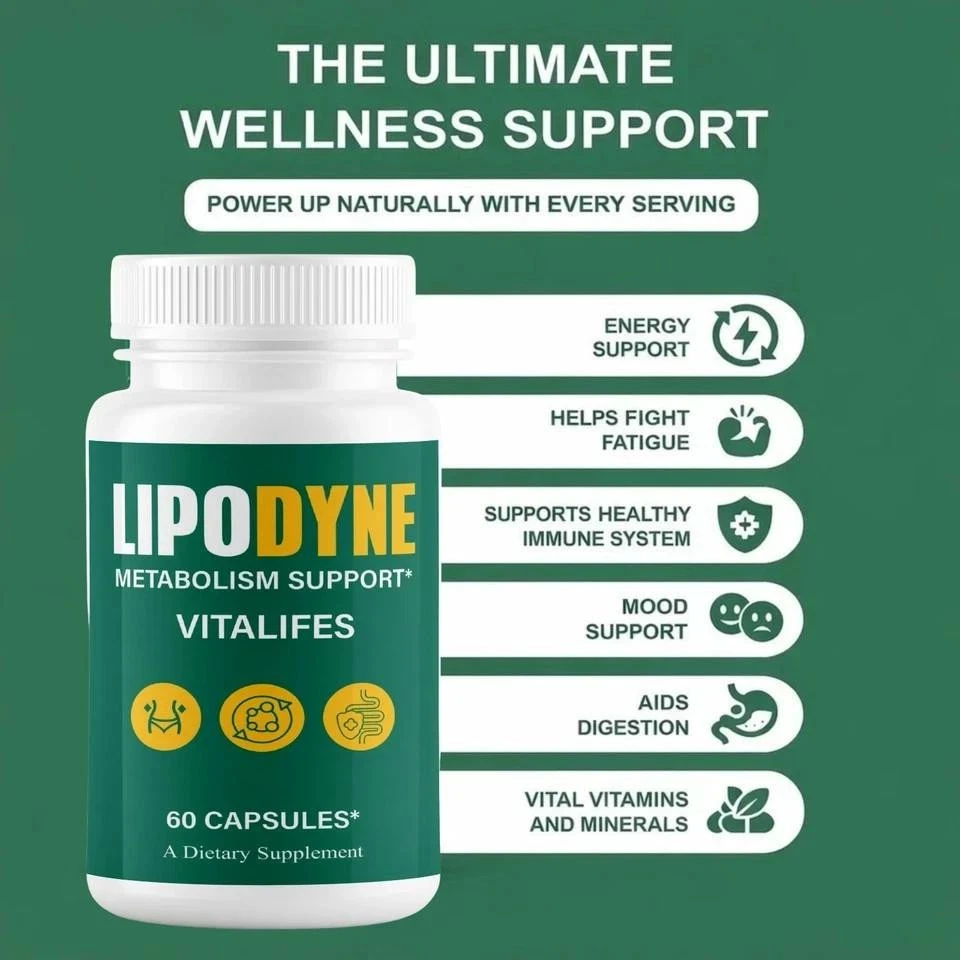
The seller ships a wellness graphic whose final line reads “Vital vitamins and minerals”. The Supplement Facts panel carries six botanical and stimulant rows and no vitamin and no mineral of any kind.
Both cannot describe the same capsule, and the panel is the document that governs. It is the regulated part of the packaging, it is what a buyer with a dietary question is entitled to rely on, and it lists what is in the bottle.
So this is a six-ingredient botanical and stimulant formula. Anybody buying it as a multivitamin has bought the wrong thing, and that is the single most consequential misreading this product invites.
How to check the LipoDyne ingredients on the bottle you receive
What to look at when the bottle arrives, in the order worth looking.
Read the panel, not the front
The front of a bottle carries marketing and the back carries the declaration. Turn it round and look for six rows and a serving size of one capsule.
Count the rows before you count the milligrams
Six actives is the signature of this formula. A bottle arriving with a different count is a different product, whatever the front says.
Check the caffeine figure first
It is the row with the most practical consequence and the one with no interpretation in it. One hundred milligrams a capsule is what this panel prints.
Read the other-ingredients line for the shell
Vegetable cellulose is what this label prints. A gelatin shell would mean the bottle in your hand is not the product described here.
Hold the lot number against your order
Lot LIP-26/GO-7994 is the run this desk ships. The batch page covers what a lot number can and cannot tell you.
Five checks, none of which needs anything except the bottle and two minutes. They exist because the most common problem in this category is not a bad formula but a different one arriving under a familiar name.
Who publishes this LipoDyne website?
- Heymsfield SB, Allison DB, Vasselli JR, Pietrobelli A, Greenfield D, Nunez C. Garcinia cambogia (hydroxycitric acid) as a potential antiobesity agent: a randomized controlled trial. JAMA. 1998;280(18):1596-600. PMID 9820262. https://pubmed.ncbi.nlm.nih.gov/9820262/
- Nagao T, Hase T, Tokimitsu I. A green tea extract high in catechins reduces body fat and cardiovascular risks in humans. Obesity (Silver Spring). 2007;15(6):1473-83. PMID 17557985. https://pubmed.ncbi.nlm.nih.gov/17557985/
- Chen IJ, Liu CY, Chiu JP, Hsu CH. Therapeutic effect of high-dose green tea extract on weight reduction: A randomized, double-blind, placebo-controlled clinical trial. Clin Nutr. 2016;35(3):592-9. PMID 26093535. https://pubmed.ncbi.nlm.nih.gov/26093535/
- Kondo T, Kishi M, Fushimi T, Ugajin S, Kaga T. Vinegar intake reduces body weight, body fat mass, and serum triglyceride levels in obese Japanese subjects. Biosci Biotechnol Biochem. 2009;73(8):1837-43. PMID 19661687. https://pubmed.ncbi.nlm.nih.gov/19661687/
- Castagna A, Ferro Y, Noto FR, et al. Effect of Apple Cider Vinegar Intake on Body Composition in Humans with Type 2 Diabetes and/or Overweight: A Systematic Review and Meta-Analysis of Randomized Controlled Trials. Nutrients. 2025;17(18):3000. PMID 41010525. https://pubmed.ncbi.nlm.nih.gov/41010525/
- Shishehbor F, Mansoori A, Shirani F. Vinegar consumption can attenuate postprandial glucose and insulin responses; a systematic review and meta-analysis of clinical trials. Diabetes Res Clin Pract. 2017;127:1-9. PMID 28292654. https://pubmed.ncbi.nlm.nih.gov/28292654/
- Whiting S, Derbyshire E, Tiwari BK. Capsaicinoids and capsinoids. A potential role for weight management? A systematic review of the evidence. Appetite. 2012;59(2):341-8. PMID 22634197. https://pubmed.ncbi.nlm.nih.gov/22634197/
- Irandoost P, Lotfi Yagin N, Namazi N, et al. The effect of Capsaicinoids or Capsinoids in red pepper on thermogenesis in healthy adults: A systematic review and meta-analysis. Phytother Res. 2021;35(3):1358-1377. PMID 33063385. https://pubmed.ncbi.nlm.nih.gov/33063385/
- Shoba G, Joy D, Joseph T, Majeed M, Rajendran R, Srinivas PS. Influence of piperine on the pharmacokinetics of curcumin in animals and human volunteers. Planta Med. 1998;64(4):353-6. PMID 9619120. https://pubmed.ncbi.nlm.nih.gov/9619120/
- Srinivasan K. Black pepper and its pungent principle-piperine: a review of diverse physiological effects. Crit Rev Food Sci Nutr. 2007;47(8):735-48. PMID 17987447. https://pubmed.ncbi.nlm.nih.gov/17987447/
- Cui T, Wang Q, Tian X, Zhang K, Peng Y, Zheng J. Piperine Is a Mechanism-Based Inactivator of CYP3A. Drug Metab Dispos. 2020;48(2):123-134. PMID 31748224. https://pubmed.ncbi.nlm.nih.gov/31748224/
- Dulloo AG, Geissler CA, Horton T, Collins A, Miller DS. Normal caffeine consumption: influence on thermogenesis and daily energy expenditure in lean and postobese human volunteers. Am J Clin Nutr. 1989;49(1):44-50. PMID 2912010. https://pubmed.ncbi.nlm.nih.gov/2912010/
- Navarro V, Avula B, Khan I, et al. The Contents of Herbal and Dietary Supplements Implicated in Liver Injury in the United States Are Frequently Mislabeled. Hepatol Commun. 2019;3(6):792-794. PMID 31168513. https://pubmed.ncbi.nlm.nih.gov/31168513/
Six LipoDyne rows, every amount printed on the bottle
One capsule a day, 60 to a bottle, and a panel that prints a figure against every row rather than hiding six of them inside one total.
$22.62 a bottle, 60 capsules · 30-day returns, seller pays postage
Order LipoDyne On The Official WebsiteOne capsule a day · 60 per bottle · lot LIP-26/GO-7994