LipoDyne Official Website › Supplement Facts
Supplement FactsLipoDyne Supplement Facts
Six rows, an amount against every one, and a Daily Value column with nothing in it.
Serving size one capsule, servings per container 60. The six actives total 1,060 mg. Beneath them the other-ingredients line names the shell and three processing agents, and the footnote explains the daggers: no Daily Value has been established for any row.
The panel treated as the document it is, rather than as a summary of one.
The LipoDyne panel exactly as the bottle prints it
Six rows, one footnote and a four-item other-ingredients line, reproduced in full.
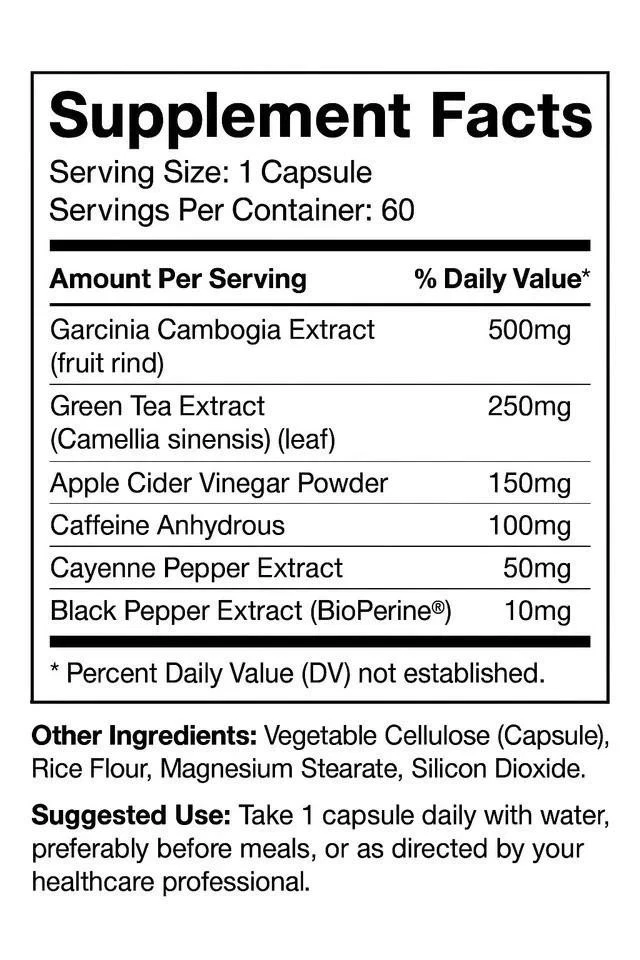
| Row | Amount per serving | % Daily Value |
|---|---|---|
| Garcinia Cambogia Extract (fruit rind) | 500 mg | † |
| Green Tea Extract (Camellia sinensis) (leaf) | 250 mg | † |
| Apple Cider Vinegar Powder | 150 mg | † |
| Caffeine Anhydrous | 100 mg | † |
| Cayenne Pepper Extract | 50 mg | † |
| Black Pepper Extract (BioPerine) | 10 mg | † |
Serving size 1 capsule. Servings per container 60. The dagger marks a row for which no Daily Value has been established, which on this panel is every row: the % Daily Value column carries a heading and no figures.
Other ingredients: vegetable cellulose (capsule), rice flour, magnesium stearate, silicon dioxide.
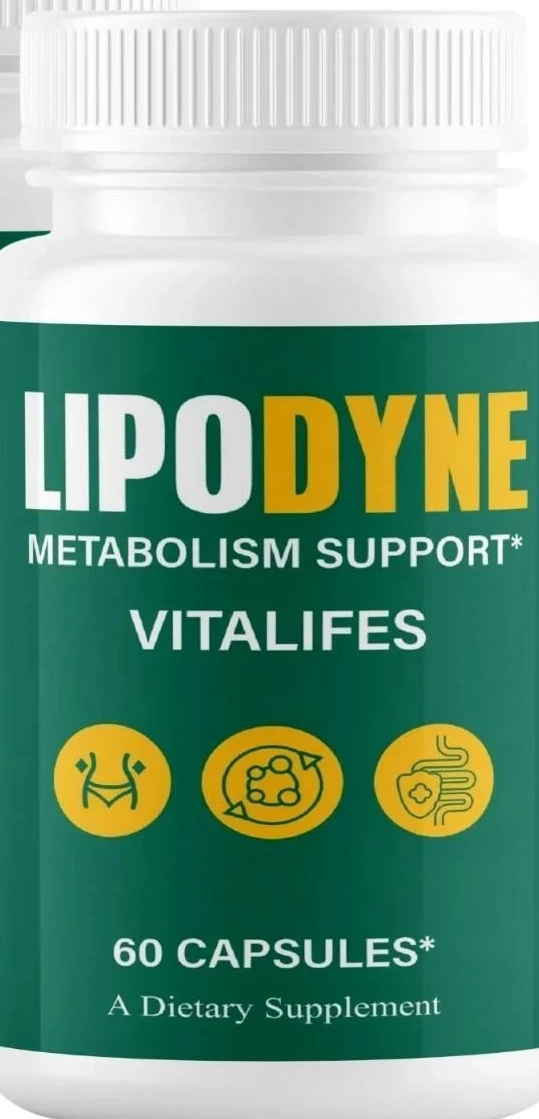
Everything a buyer is entitled to rely on about the contents of this capsule is in that box. The front of the bottle carries a product name, a category line and a capsule count; the panel carries the declaration.
The order of the rows is itself information. A Supplement Facts panel lists its actives by weight, heaviest first, and this one descends cleanly from 500 mg to 10 mg with no ties. That tells a reader the garcinia row is the bulk of the fill and the pepper row is a rounding detail.
There is no proprietary blend line anywhere on it. That single absence is the reason every other page on this website can be specific, and it is rarer in this category than the shelf suggests.
What one LipoDyne serving is, and what a bottle comes to
Six figures from the panel, and what each one decides about a bottle.
| Figure | As printed | What follows from it |
|---|---|---|
| Serving size | 1 capsule | There is no split dose and no second serving described anywhere on the artwork. |
| Servings per container | 60 | 60 capsules is 60 days at the label rate, so the bottle is a two-month supply. |
| Actives per serving | 1,060 mg | The six rows added together, an arithmetic the panel permits because every row carries a figure. |
| Actives per bottle | 63.6 g | 1,060 mg times 60. Useful only as a sense of scale for what is being bought. |
| Caffeine per serving | 100 mg | A quarter of the 400 mg daily reference figure for healthy adults, and the number with the most practical consequence on the panel. |
| Capsule shell | Vegetable cellulose | Plant-derived, so the product sits inside a vegetarian diet. |
Every figure in the middle column is printed on the panel. The right-hand column is arithmetic anyone can repeat.
Two of those lines settle questions that come up constantly. The serving size decides that this is a one-capsule product rather than a two-capsule product dressed as one, which changes the cost per day and the caffeine total in the same stroke.
The shell decides a dietary question outright. A vegetable cellulose capsule is printed on the label rather than asserted by a badge, which is the correct order for that kind of claim.
The container line is the one to hold against the invoice. 60 servings at one a day is the arithmetic the price on the pricing page is divided by.
Why every LipoDyne row carries a dagger instead of a percentage
An empty column is a statement, and on this panel it is quite an informative one.
The % Daily Value column on this panel has a heading and no numbers. A dagger sits in every row and the footnote reads that no Daily Value has been established.
That is correct labelling rather than an omission. Daily Values exist for nutrients with a published intake reference: vitamins, minerals, protein, fibre and the rest. Botanical extracts and caffeine have no such reference, so there is no percentage to print and a responsible label prints a dagger.
It also tells a reader something about the formula. A panel where every single row carries the dagger contains no vitamin and no mineral at all, which is the shortest available proof that this is a botanical and stimulant product. Anyone who wants to check the claim made elsewhere on this site that there are no vitamins in the bottle can check it in that column without reading a word of the rows.
The dagger is reproduced on this website in place of the asterisk the bottle uses. A loose asterisk in body copy reads as a claim marker pointing at a footnote that is not there, and the symbol was changed rather than the meaning.
What the LipoDyne other-ingredients line is for
A list with a different job from the one above it, and what it can be asked.
Beneath the actives every panel carries a second list, and its job is different. The actives list what the product is sold for. The other-ingredients list what else is in the capsule, in descending order of weight, with no amounts given.
This one reads: vegetable cellulose (capsule), rice flour, magnesium stearate, silicon dioxide. Four entries, and the convention means the shell is the heaviest of them.
No amounts appear on this list anywhere in the category, which is normal and worth knowing rather than resenting. The regulation asks for identity and order, not quantity, on the grounds that these materials are present for manufacture rather than for effect.
For a buyer the line answers three questions and no others: what the shell is made of, whether a known allergen is present, and whether anything on it conflicts with a dietary rule. On this bottle the answers are vegetable cellulose, nothing declared, and no conflict with a vegetarian diet.
LipoDyne: 60 capsules on the bottle, 120 on the marketplace listing
One number appears twice on the bottle and once, differently, in a metadata field.
The bottle artwork prints “60 Capsules” and the panel prints “Servings Per Container: 60”. The marketplace listing’s item specifics field prints “Number of Pills: 120”.
The label is the document that governs and the figure is 60. Two independent places on the packaging agree on it, the panel arithmetic depends on it, and item specifics on a marketplace listing are a seller-entered metadata field rather than part of the product.
Three other fields in the same block describe a different product entirely: “Ingredients: Multivitamin, Vitamin B12”, “Dosage: 5 mg” and “Organic”. The panel has no vitamin, no mineral, no 5 mg row and no organic certification anywhere on it. Taken together those four fields look like a template left unedited rather than a description of this bottle.
The consequence for a buyer is a price one, and it is settled on the pricing page: a bottle is 60 capsules, so the cost per capsule is $0.38 and not half that. Anyone who budgeted on the listing figure has budgeted for twice the supply.
Honest label analysis: what the LipoDyne panel cannot establish
Three questions a Supplement Facts panel is not built to answer, this one included.
Three things sit outside what this panel can settle, and they are collected here rather than repeated beside every row.
Extract strength. Five of the six rows are plant concentrates and none carries a standardisation percentage. The garcinia row gives a weight of extract rather than a weight of hydroxycitric acid; the green tea row gives a weight of extract rather than a weight of catechins or EGCG. The ingredients page works through what that costs a reader.
Provenance. A panel names materials, not origins. Where the garcinia was grown, who extracted it and to what specification are questions the bottle does not answer, and the “foreign and domestic ingredients” seal on the pack is a sourcing disclosure rather than an answer. The quality page reads every seal in turn.
Identity testing. A printed amount is a specification the manufacturer has committed to. It is not a laboratory result for the bottle in your hand. An assay of products in this wider category is the reason the distinction matters, and no certificate accompanies a retail bottle in this category from any seller.
None of those three is unusual and none is hidden. They are the standing limits of a supplement panel, and a reader who knows them can get a great deal out of this one.
What a better LipoDyne panel would print
Six rows, and the one line each of the five extracts is missing.
| What this panel gives | What a stronger label would add | Why it would matter |
|---|---|---|
| Garcinia Cambogia Extract, 500 mg | Standardised to 60 per cent hydroxycitric acid (300 mg HCA) | It would let a reader compare the row with the 1,500 mg used in the JAMA trial instead of guessing at it. |
| Green Tea Extract (leaf), 250 mg | Standardised to 50 per cent catechins, 25 per cent EGCG | The two trials that moved body fat are reported in catechins and EGCG, and this row cannot presently be set beside either. |
| Apple Cider Vinegar Powder, 150 mg | 5 per cent acetic acid (7.5 mg) | Vinegar research is measured in acetic acid, and a powder's share of it varies widely between suppliers. |
| Cayenne Pepper Extract, 50 mg | Standardised to 2 per cent capsaicinoids (1 mg) | Every thermogenesis trial for this plant reports capsaicinoid milligrams. |
| Black Pepper Extract (BioPerine), 10 mg | 95 per cent piperine (9.5 mg) | BioPerine has a published specification; printing it would remove the ambiguity between extract weight and piperine weight. |
| Caffeine Anhydrous, 100 mg | Nothing. This row is already complete. | A single defined compound needs no percentage, which is why it is the one row this website quotes without qualification. |
The middle column shows the FORM a stronger label takes, using figures typical of commercial extracts. They are illustrations of what a standardisation line looks like and not statements about this product.
Five lines of extra print is the whole difference between a panel a reader can check and a panel a reader can only read. It costs nothing to add and a number of labels in this category do add it.
The reason this table is worth publishing on a website that sells the product is that the bottle is already most of the way there. A label that prints six amounts and no blend has done the hard part; the remaining gap is a specification line, and naming it is more useful to a buyer than pretending it is closed.
Who publishes this LipoDyne website?
- Navarro V, Avula B, Khan I, et al. The Contents of Herbal and Dietary Supplements Implicated in Liver Injury in the United States Are Frequently Mislabeled. Hepatol Commun. 2019;3(6):792-794. PMID 31168513. https://pubmed.ncbi.nlm.nih.gov/31168513/
- Heymsfield SB, Allison DB, Vasselli JR, Pietrobelli A, Greenfield D, Nunez C. Garcinia cambogia (hydroxycitric acid) as a potential antiobesity agent: a randomized controlled trial. JAMA. 1998;280(18):1596-600. PMID 9820262. https://pubmed.ncbi.nlm.nih.gov/9820262/
- Nagao T, Hase T, Tokimitsu I. A green tea extract high in catechins reduces body fat and cardiovascular risks in humans. Obesity (Silver Spring). 2007;15(6):1473-83. PMID 17557985. https://pubmed.ncbi.nlm.nih.gov/17557985/
- Kondo T, Kishi M, Fushimi T, Ugajin S, Kaga T. Vinegar intake reduces body weight, body fat mass, and serum triglyceride levels in obese Japanese subjects. Biosci Biotechnol Biochem. 2009;73(8):1837-43. PMID 19661687. https://pubmed.ncbi.nlm.nih.gov/19661687/
- Whiting S, Derbyshire E, Tiwari BK. Capsaicinoids and capsinoids. A potential role for weight management? A systematic review of the evidence. Appetite. 2012;59(2):341-8. PMID 22634197. https://pubmed.ncbi.nlm.nih.gov/22634197/
- Shoba G, Joy D, Joseph T, Majeed M, Rajendran R, Srinivas PS. Influence of piperine on the pharmacokinetics of curcumin in animals and human volunteers. Planta Med. 1998;64(4):353-6. PMID 9619120. https://pubmed.ncbi.nlm.nih.gov/9619120/
- Wikoff D, Welsh BT, Henderson R, et al. Systematic review of the potential adverse effects of caffeine consumption in healthy adults, pregnant women, adolescents, and children. Food Chem Toxicol. 2017;109(Pt 1):585-648. PMID 28438661. https://pubmed.ncbi.nlm.nih.gov/28438661/
The LipoDyne panel prints a figure against every row
Six actives, 1,060 mg a capsule, no proprietary blend and 60 capsules in the bottle. Everything on this page can be held against the label in your hand.
$22.62 a bottle, 60 capsules · 30-day returns, seller pays postage
Order LipoDyne On The Official WebsiteOne capsule a day · 60 per bottle · lot LIP-26/GO-7994